

Key Takeaways
- Private label lets you sell a quality food product under your own brand without owning a factory.
- Private label, white label and contract manufacturing differ mainly in how customised the recipe is — pick by how unique you want to be.
- The process runs consultation → recipe → packaging → samples → production, with samples approved before any bulk run.
- MOQ, certifications (BRCGS, FSSAI, USDA Organic) and cost depend on the product, packaging and order volume.
- As a private-label manufacturer, we at Insight Food Private Limited handle recipe customisation, certified production and export — already for 50+ brands.
Launching your own food brand without building a factory is exactly what private label food manufacturing in India makes possible. A certified manufacturer produces the product to your recipe and packs it under your brand — so you can focus on selling. This guide explains how it works, the difference between private label, white label and contract manufacturing, typical MOQs and certifications, and how to choose the right partner.
What is private label food manufacturing?
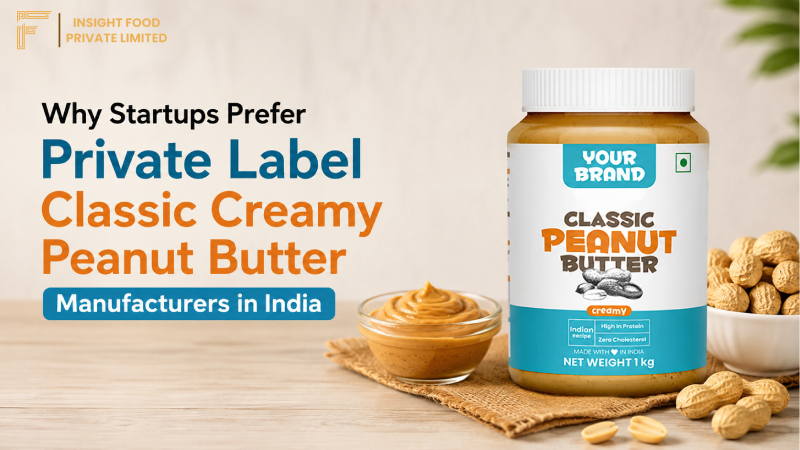
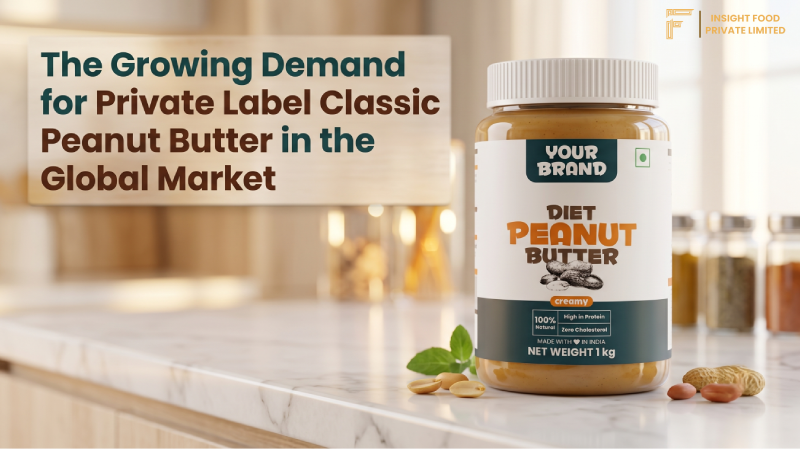
In private label manufacturing, a producer makes a food product that is sold under your brand name and packaging rather than theirs. You own the brand; the manufacturer owns the production. For categories like peanut butter, nut butters, peanut powder, rice cakes and muesli, this lets retailers, FMCG brands, D2C startups and importers go to market with a quality product without the capital cost of a certified facility.
Private label vs white label vs contract manufacturing
These terms are often used interchangeably, but they mean different things:
| Model | What it means | Best for |
|---|---|---|
| Private label | Manufacturer’s product/recipe, customised & sold under your brand & packaging | Fast launch with a proven product |
| White label | A generic, ready product re-branded by multiple sellers | Lowest cost, quickest entry |
| Contract / OEM manufacturing | Manufacturer produces your custom recipe & spec exclusively | Differentiated, proprietary products |
Many real-world projects are a blend — you start from the manufacturer’s base recipe (private label) and customise sweetness, texture, oil content or packaging until it’s distinctly yours.
How the private label process works
1. Consultation & product selection
You discuss your target product, market, price point and packaging. The manufacturer recommends a base recipe and format.
2. Recipe customisation
Sweetness, salt, texture (smooth/crunchy), oil/fat profile, organic vs conventional and ingredient claims are tuned to your brief.
3. Packaging & label design
You choose jar/pouch/pail sizes and provide artwork; the manufacturer advises on food-grade packaging and regulatory labelling (ingredients, nutrition, allergens, FSSAI/destination-market requirements).
4. Sample development & approval
Samples are produced for you to taste-test and approve before any bulk run. Reputable manufacturers offer samples on qualified enquiries.
5. Production, QA & dispatch
On approval, the batch is produced under the facility’s food-safety system, quality-checked, packed and dispatched — domestically or for export.
MOQs, certifications & costs
Minimum order quantity (MOQ) varies by product and packaging — smaller for standard jars, higher for fully custom recipes or packaging. Certifications to look for include BRCGS, HACCP, FSSAI, and USDA Organic / Halal / Kosher where your market needs them. Cost depends on recipe complexity, packaging, order volume and certification requirements; higher volumes lower the per-unit price.
Why manufacture private-label food in India?
- Cost-competitive raw materials and production, especially for groundnut-based products.
- Globally recognised certifications (BRCGS, USDA Organic) that satisfy retail and export buyers.
- Export infrastructure — established logistics and documentation for shipping worldwide.
- Scale & flexibility — from D2C startup volumes to large retail programmes.
How to choose a private label manufacturing partner
- Verify certifications and ask to see the scope (which products/lines are covered).
- Check they offer recipe customisation and pre-production samples.
- Confirm packaging options and regulatory/labelling support for your market.
- Ask about MOQ, lead time, and export documentation if you’re shipping abroad.
- Look for transparent communication and a structured onboarding process.
Insight Food offers private-label & contract manufacturing of peanut butter, nut butters, peanut powder, rice cakes and muesli from a BRCGS & USDA-Organic certified facility — already trusted by 50+ brands.
👉 See our private-label process | Book a consultation
Frequently asked questions
u003cstrongu003eWhat is private label food manufacturing?u003c/strongu003e
It’s when a certified manufacturer produces a food product to your specification and packs it under your own brand and label, so you can sell it as your own without operating a factory.
u003cstrongu003eWhat is the difference between private label and white label?u003c/strongu003e
White label is a generic ready-made product re-branded by many sellers. Private label is customised to your brand — recipe, packaging and labelling tailored to you.
u003cstrongu003eWhat is the minimum order quantity for private label food?u003c/strongu003e
MOQ depends on the product and packaging. Standard formats have lower MOQs; fully custom recipes or packaging require higher volumes. Ask the manufacturer for the specific product you want.
u003cstrongu003eWhat certifications should a private label food manufacturer have?u003c/strongu003e
BRCGS and HACCP for food safety, FSSAI for India, and USDA Organic, Halal or Kosher depending on your product claims and target markets.
u003cstrongu003eCan I get samples before placing a bulk order?u003c/strongu003e
Yes. Reputable manufacturers develop and share samples for approval before any bulk production run, usually on qualified enquiries.